
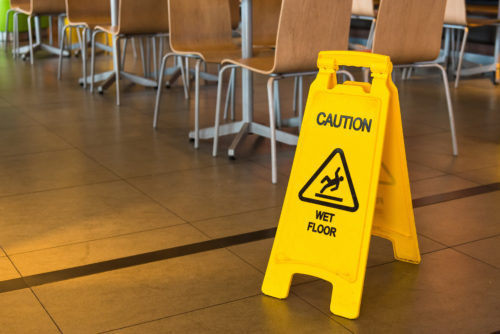
If you were injured in a fast food restaurant because of the negligence of another, continue reading and give our firm a call today. Our Prince George’s County slip and fall lawyer is on your side no matter what you are facing.
How do slip and fall accidents happen at fast food restaurants?
Fast food restaurants have more possible dangers than most businesses because of the messy nature of operating with food and also its fast-paced environment. Some typical ways that people slip and fall in a fast food restaurant include:
- Fall over debris left on the floor or damaged surfaces in the parking lot
- Slip on a spill near the soda dispenser
- Slip on water or trip over a loose tile in the bathroom
- Trip over an upside-down rug or mat
- Slide on dropped food
It is important to understand that the above-mentioned reasons are not a complete list and not every individual that slips and falls in a fast food restaurant may be qualified to obtain financial compensation for their injuries.
Who can be held responsible for a slip and fall accident in Maryland?
If you fall and sustain an injury, you may choose to file a lawsuit against the business for which the incident took place. Once you choose your decisions, it is then up to you, the injured party, to establish that the company or employees that are responsible for your injury. This will require proof of liability or negligence.
How do I establish negligence?
The best way to establish liability or negligence is by revealing that the property owner or manager should have known about the dangerous condition because any reasonable person would know and warn customers in a comparable instance. You may also want to demonstrate that the property owner, manager, or employee caused the dangerous condition and should have reasonably assumed that someone would slip and fall.
The standard for reasonableness is established on how the average, prudent person would handle the situation. Some other aspects that you should think about when trying to figure out if the defendant was negligent include the following:
- Did the property owner, manager, or employees have a policy that required a routine check of the property for potential hazards? If they did, is there a log to demonstrate that these requirements were satisfied?
- How was the lighting and visibility in the area where you experienced the fall?
- Did the dangerous condition or obstacle exist long enough that the property owner had more than enough time to take action and remove it?
- Was any warning signage or barrier to prevent access present that could make the dangerous condition less serious?
- Did the property owner or manager have a reasonable excuse for creating the hazard? If they did, is there an explanation for how long it was there?
- Establishing liability in a slip-and-fall case is not easy. The first response of the property owner is usually to argue that you are either fully or partially responsible for the incident. The burden to prove otherwise is your duty.
Contact Our Firm
If you suffered an injury or loss because of another person’s negligence, contact McCarthy, Winkelman & Mester, L.L.P. today.


